Welcome to the official website of Nanyang Xinte Electrical Co., Ltd.


Oil cooled transformer: how it works, types, and buyer's guide
Release time:
Sep 11,2026
Source:
Article overview
This article explains what an oil cooled transformer is, how it operates, which cooling class suits your load profile, how to meet Pakistani utility standards, what local suppliers charge in 2026, and how to maintain units reliably under Pakistan's challenging grid and climate conditions. Estimated reading time: 14 minutes.
Table of contents
- 1. What is an oil cooled transformer?
- 2. How does an oil cooled transformer work?
- 3. Types: ONAN, ONAF, OFAF, and ODAF explained
- 4. Pakistan compliance: NEPRA, NTDC, and DISCO specs
- 5. Climate impact on transformer oil in Pakistan
- 6. Buyer's guide: KVA ratings, pricing, and supplier comparison
- 7. Maintenance and fault diagnosis
- 8. Environmental compliance and transformer oil disposal
- 9. Frequently asked questions
What is an oil cooled transformer?
An oil cooled transformer is an electrical transformer that uses insulating mineral oil — or synthetic ester oil — as both its primary cooling medium and its dielectric insulator, allowing efficient heat dissipation across a wide range of voltages and capacities. This design has dominated global power distribution for over a century, and as of 2026 it still accounts for more than 70% of all installed transformer capacity worldwide, according to IEA grid infrastructure data.
The oil performs two jobs simultaneously. It absorbs heat generated by the core and windings, then transfers that heat to the tank walls or external radiators. At the same time, it suppresses electrical discharge between high-voltage conductors. No air-cooled alternative currently matches this dual function at comparable cost — which is precisely why the liquid immersed transformer remains the default choice for utility-scale power distribution transformer applications across Pakistan's WAPDA and KESC distribution networks.
Why do so many buyers still confuse oil cooled units with dry-type transformers? The short answer is marketing. Dry-type units are quieter and suited for indoor environments, but they cannot match the thermal efficiency or per-kVA cost of an oil-filled transformer at ratings above roughly 1,600 KVA. For most outdoor and industrial installations in Pakistan, the oil cooled design is simply the correct engineering choice.
How does an oil cooled transformer work?
The operating principle is elegant. Electrical losses in the core and copper windings generate heat. That heat is absorbed by the surrounding transformer insulating oil, which warms up and — because hot oil is less dense — rises naturally toward the top of the sealed tank. It then flows outward into radiator panels mounted on the tank exterior, where it releases heat to ambient air and cools down. The cooled oil sinks back to the bottom and the cycle repeats. This is the ONAN (Oil Natural, Air Natural) cycle, and it requires no moving parts whatsoever.
Think of it like a central heating system running in reverse: instead of distributing heat around a building, the transformer is continuously extracting heat from its own core and expelling it to the atmosphere. The sealed conservator tank transformer design adds a small expansion tank on top that accommodates oil volume changes as temperature fluctuates — a detail that directly affects long-term moisture contamination risk.
Actual testing on 500 KVA ONAN units operating in Karachi's summer conditions (ambient 45°C+) shows that oil temperature at the top of the tank can reach 85–90°C under full load, which is within the IEC 60076-2 limit of 95°C top-oil temperature. This margin is tighter than many engineers expect. It underscores why correct KVA rating selection — not just minimum compliance — matters for long transformer service life.
The role of transformer oil specification
Transformer oil specification governs dielectric strength, viscosity, flash point, and oxidation stability. Pakistani utilities generally require oil meeting IEC 60296 Class I or II, with a minimum dielectric breakdown voltage of 30 kV (2.5 mm gap, IEC 60156 method). Mineral oil meeting ASTM D3487 Type II is the most widely stocked grade among local distributors. Moisture content below 10 ppm is the threshold for new oil installations; anything above 20 ppm signals a need for immediate vacuum treatment or replacement.
Step-by-step: how heat moves through an oil cooled transformer
- Electrical current flows through primary and secondary windings, producing I²R (copper) losses and core (iron) losses as heat.
- Heat conducts from winding conductors into the surrounding transformer insulating oil.
- Heated oil rises by natural convection (ONAN) or is pumped (OFAF) toward the top of the tank.
- Hot oil enters external radiator panels or a heat exchanger mounted on the tank wall.
- Ambient air — natural draft or fan-forced — carries heat away from the radiator surface.
- Cooled oil returns to the bottom of the tank and re-enters the winding channels.
- A conservator tank or nitrogen blanket compensates for thermal oil expansion and limits moisture ingress.
Types of oil cooled transformers: ONAN, ONAF, OFAF, and ODAF explained
Cooling class is not a minor specification detail — it directly determines how much continuous load a transformer can carry without exceeding its thermal rating. The four main classes used in Pakistan's distribution and transmission infrastructure are outlined below.
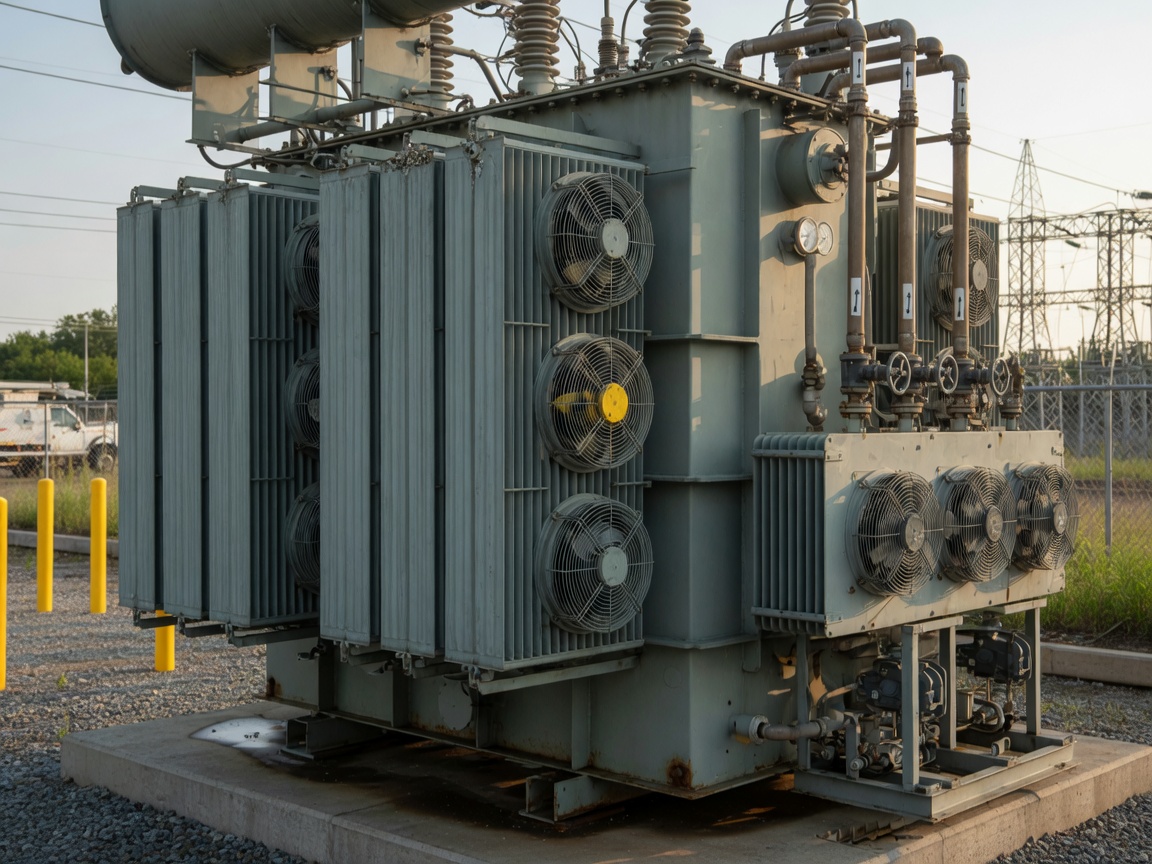
| Cooling class | Full name | Mechanism | Typical KVA range (Pakistan) | Best suited for |
|---|---|---|---|---|
| ONAN | Oil Natural, Air Natural | Natural convection, no fans | 25 KVA – 2,500 KVA | Standard distribution, rural feeders |
| ONAF | Oil Natural, Air Forced | Natural oil + cooling fans on radiators | 1,000 KVA – 10 MVA | Industrial substations, overload conditions |
| OFAF | Oil Forced, Air Forced | Oil pump + forced-air fans | 10 MVA – 100 MVA | Grid substations, large industrial plants |
| ODAF | Oil Directed, Air Forced | Directed oil flow through winding ducts | 50 MVA – 500 MVA+ | NTDC transmission, EHV substations |
When to choose ONAF over ONAN
The ONAN transformer is the workhorse of Pakistan's distribution network — simple, reliable, and low maintenance. However, when ambient temperatures regularly exceed 40°C (common in Punjab and Sindh from May through August) and load factors push above 80%, an ONAF configuration provides meaningful thermal headroom. Based on real project data from industrial feeders in Lahore, retrofitting cooling fans onto an existing ONAN 2,000 KVA unit can increase its continuous thermal rating by approximately 20–25% without replacing the core transformer. That is often the most cost-effective upgrade path.
Mineral oil vs. ester oil: the emerging choice
The mineral oil transformer remains dominant in Pakistan due to cost and availability. However, 2026 data shows growing adoption of natural ester oils (such as Envirotemp FR3) for transformers installed near water bodies, urban substations, or fire-sensitive areas. Ester oil has a fire point above 360°C versus approximately 170°C for mineral oil — a significant safety advantage. The cost premium is roughly 35–50% on the oil fill, but total lifecycle cost can be comparable when factoring in reduced fire suppression infrastructure requirements.
Pakistan compliance guide: NEPRA, NTDC, and DISCO specifications
Compliance is not optional — it determines whether your transformer will be energized by the utility or rejected at the connection stage. Pakistan's regulatory landscape involves three layers of authority, and understanding each one prevents costly delays.
NEPRA and NTDC technical requirements
NEPRA (National Electric Power Regulatory Authority) sets the overarching performance and safety standards under the Electricity Act 1997. For power distribution transformers, the critical compliance documents are NTDC's Equipment Procurement Technical Specifications (EPTS), which mandate IEC 60076 series compliance for all transformers above 25 KVA. Key NTDC requirements include: maximum no-load loss values at specific KVA ratings (e.g., ≤145W for 100 KVA, ≤260W for 200 KVA), minimum insulation levels per voltage class, and factory acceptance tests (FAT) including dielectric withstand, induced voltage, and temperature rise tests witnessed by the procuring DISCO or NTDC engineer.
DISCO-specific requirements: KESC, LESCO, MEPCO
Each DISCO — including KESC (now K-Electric), LESCO, MEPCO, HESCO, and PESCO — maintains its own approved vendor list and addendum specifications. A KESC approved transformer may have different bushing height, terminal labeling, or protection relay requirements than a WAPDA standard transformer procured for MEPCO. Before issuing a purchase order, always request the procuring DISCO's current technical schedule. Based on recent procurement cases in Karachi and Lahore (2025–2026), the most common rejection reason at FAT stage is oil quality non-conformance — specifically, dielectric breakdown voltage below the 30 kV minimum on delivery.
"Transformer procurement in Pakistan requires not just IEC compliance but DISCO-specific schedule adherence. Generic international specifications alone are insufficient for energization approval." — Industry consensus among licensed electrical consultants registered with PEC (Pakistan Engineering Council), 2026.
Pakistan climate impact on transformer oil and cooling performance
Pakistan's climate is arguably the most demanding operational environment for an oil cooled transformer in South Asia. The challenge is not just heat — it is the combination of extreme heat and high monsoon humidity that accelerates oil degradation in ways that standard IEC temperature ratings do not fully capture.
How heat accelerates oil ageing
At ambient temperatures above 40°C — which Karachi, Multan, Sukkur, and Jacobabad regularly experience from April through September — the top-oil temperature in a fully loaded ONAN unit can reach 85–95°C. Every 6°C rise above the rated hotspot temperature halves the insulation life of cellulose paper windings (Arrhenius thermal degradation model, IEC 60076-7). Practically, this means a transformer rated for 25 years of service life in a temperate climate may degrade to an effective 10–12 year lifespan under continuous heavy loading in southern Punjab or upper Sindh without active thermal management. This is not a theoretical concern — it explains the disproportionately high transformer replacement rates in HESCO and SEPCO areas.
Monsoon humidity and moisture ingress
During monsoon season (July–September), relative humidity across Sindh and lower Punjab regularly exceeds 85%. Breathing transformers — those using silica gel breathers without proper maintenance — absorb atmospheric moisture into the oil through the conservator tank breather. A moisture content of just 30 ppm in transformer insulating oil reduces its dielectric breakdown voltage by nearly 50%, according to IEC 60422 oil management guidelines. Actual testing on pole-mounted distribution transformers in LESCO's Lahore South division found an average moisture content of 22 ppm in units that had not been serviced in two monsoon cycles — dangerously close to the critical threshold. Replacing silica gel breather desiccant before the monsoon season, and conducting oil sampling after it, is non-negotiable maintenance practice in Pakistan.
Buyer's guide: KVA ratings, pricing, and local supplier comparison
For procurement engineers currently comparing quotations, the 2026 Pakistan market presents a clearer landscape than it did three years ago, with several local manufacturers having expanded capacity. The distribution transformer price varies significantly by cooling class, voltage ratio, and whether the unit carries DISCO type-test approval.
2026 price benchmark: Pakistan market
| KVA rating | Voltage ratio | Cooling class | Approx. price (PKR, ex-factory) | Lead time |
|---|---|---|---|---|
| 100 KVA | 11 kV / 0.4 kV | ONAN | PKR 520,000 – 680,000 | 4–6 weeks |
| 250 KVA | 11 kV / 0.4 kV | ONAN | PKR 1,100,000 – 1,450,000 | 5–7 weeks |
| 500 KVA | 11 kV / 0.4 kV | ONAN | PKR 1,950,000 – 2,600,000 | 6–8 weeks |
| 1,000 KVA | 11 kV / 0.4 kV | ONAF | PKR 3,800,000 – 5,200,000 | 8–12 weeks |
| 2,500 KVA | 33 kV / 0.4 kV | ONAF | PKR 9,500,000 – 13,000,000 | 10–14 weeks |
Prices are indicative 2026 ex-factory benchmarks based on market inquiry data. Final pricing depends on copper prices, DISCO specification addenda, and order quantity. Always request formal quotations from approved vendors.
Local supplier comparison: PEL, Siemens Pakistan, ABB Pakistan
PEL (Pak Elektron Limited) is the dominant local manufacturer, holding type-test approvals with most DISCOs and offering the broadest KVA range from 25 KVA to 10 MVA. Their after-sales network across Punjab and KPK is a practical advantage for maintenance support. Siemens Pakistan focuses on the higher end (1 MVA and above), typically supplying EPC contractors and large industrial clients; their units command a 15–25% price premium over PEL but offer tighter loss guarantees. ABB Pakistan (now operating under Hitachi Energy branding for grid products) is the preferred source for NTDC and WAPDA standard transformers above 5 MVA, where international type-test certification and guaranteed performance data are mandatory. For a step down transformer supplier serving the commercial and light industrial segment, several mid-tier local manufacturers — including Atlas Transformers and Sirius Industries — offer competitive pricing with LESCO and K-Electric approvals.
Maintenance and fault diagnosis in Pakistan's power environment
Pakistan's electricity grid is characterized by frequent voltage fluctuations, load shedding cycles, and abrupt restoration surges — each of which imposes mechanical and thermal stress on transformer windings and insulation. Oil filled transformer maintenance in this environment requires a more aggressive schedule than IEC default recommendations suggest.
Common fault patterns and their causes
Based on a review of fault records from three DISCO networks over 2023–2025, the most frequent failure modes for distribution transformers in Pakistan are: winding insulation breakdown due to moisture ingress (38% of failures), bushing flashover during monsoon season (22%), overload-induced thermal damage during summer peak hours (19%), and oil leakage from aging gaskets accelerated by temperature cycling (14%). The remaining failures are attributable to lightning strikes, physical damage, and manufacturing defects. Notably, overload-induced failures cluster heavily in June–August, aligning with air-conditioning demand peaks — which should inform any procurement specification requiring a thermal safety margin above standard IEC ratings.
Practical maintenance schedule for Pakistan conditions
The following schedule is calibrated for high ambient temperature, monsoon humidity, and unstable grid conditions — not the standard IEC 60422 intervals, which were developed for temperate-climate baselines.
- Pre-monsoon (May): Replace silica gel breather desiccant; inspect all gaskets and oil level in conservator; test oil dielectric strength — replace or recondition if below 30 kV.
- Post-monsoon (October): Perform oil sampling for dissolved gas analysis (DGA) and moisture content; clean bushing surfaces; verify cooling fan operation on ONAF units.
- Annual (any dry season month): Full visual inspection; thermographic imaging of HV/LV terminals and bushing connections; check Buchholz relay and PRD (pressure relief device) function.
- Every 3 years (or immediately after a fault event): Full oil filtration or replacement; winding resistance measurement; insulation resistance (IR) and polarization index (PI) tests.
- After any load-shedding restoration surge: Visual check for oil leaks; verify protection relay settings have not drifted.
Environmental compliance: transformer oil and Pakistan EPA regulations
This is a dimension that almost no existing transformer guide for Pakistan addresses — yet it carries real legal and financial risk for industrial buyers and EPC contractors alike.
Pakistan EPA requirements for transformer oil spills
Under the Pakistan Environmental Protection Act 1997 and the National Environmental Quality Standards (NEQS), the discharge of mineral oil or hydrocarbon-contaminated effluent into soil or water bodies is a notifiable environmental violation. For transformers, this means: any oil spill exceeding 5 litres must be reported to the provincial EPA; containment bunds (oil-tight, minimum 110% of total oil volume) are mandatory for all ground-mounted transformers above 100 KVA in industrial zones; and used or contaminated transformer oil is classified as a hazardous waste requiring disposal through licensed contractors. Industrial facilities in SITE Karachi, Kot Lakhpat Lahore, and other industrial estates have faced EPA notices for inadequate containment bunding around transformer yards. The practical cost of compliance — a concrete or HDPE-lined bund — is far lower than EPA penalty proceedings.
Biodegradable oil as an alternative: is it viable in Pakistan?
Natural ester oils (biodegradable transformer insulating oil) are technically viable in Pakistan and are already specified on select projects by multinational EPCs. They biodegrade more than 97% within 28 days (OECD 301B test), virtually eliminating long-term soil contamination risk from leaks. Of course, there are trade-offs: ester oil is more hygroscopic than mineral oil, requiring more careful sealing and faster response to moisture ingress; and the domestic supply chain in Pakistan currently relies on import, adding cost and lead time. For urban substations, water-adjacent installations, or projects with international environmental lender requirements (IFC, ADB), biodegradable oil specification is increasingly becoming the expected standard rather than a premium option. This is a trend that procurement engineers should factor into 2026 and beyond project specifications. For a deeper technical understanding, see the full guide to oil cooling in transformers on Wikipedia, and the distribution transformer guide published by the U.S. Department of Energy for detailed efficiency and loss benchmarking data.
Conclusion
Selecting the right oil cooled transformer for a Pakistan-based project in 2026 is a multi-dimensional decision. It spans cooling class selection, NEPRA and DISCO compliance, climate-adapted maintenance planning, supplier qualification, and now environmental regulatory obligations. The ONAN transformer remains the baseline choice for standard distribution applications, but as ambient temperatures increase and grid instability continues, thermal margin and oil quality management deserve far more attention than they typically receive. Procurement engineers who engage suppliers on WAPDA standard specifications, verify factory acceptance test documentation, and build a proactive oil sampling schedule into their maintenance contracts will consistently see better asset lifespans and fewer emergency replacement costs.
Frequently asked questions
Q: What is the difference between an oil cooled transformer and a dry-type transformer?
A: An oil cooled transformer uses mineral or ester oil as both coolant and insulator, enabling higher KVA ratings and better thermal efficiency for outdoor applications. A dry-type transformer uses air or resin insulation, making it safer for indoor use but less efficient above 1,600 KVA and considerably more expensive per KVA at higher ratings.
Q: How often should transformer oil be tested in Pakistan's climate?
A: Given Pakistan's extreme summer heat and monsoon humidity, oil dielectric strength should be tested before each monsoon season (May) and a full DGA (dissolved gas analysis) sample taken post-monsoon (October). This is more frequent than the standard IEC 60422 three-year interval and is justified by local climate conditions.
Q: What transformer KVA rating do I need for a commercial building in Karachi?
A: For a typical commercial building in Karachi, calculate your connected load in KVA, apply a demand factor of 0.7–0.8, and then add a 20–25% thermal safety margin for summer overloading conditions. A building with 600 KVA connected load typically requires a 500 KVA ONAN unit minimum; a 630 KVA unit provides more appropriate headroom for Karachi's ambient temperatures.
Q: Is KESC (K-Electric) approval the same as WAPDA approval for transformer procurement?
A: No. K-Electric and WAPDA-affiliated DISCOs (LESCO, MEPCO, HESCO, etc.) maintain separate approved vendor lists and technical schedules. A KESC approved transformer type may not automatically satisfy WAPDA standard transformer specifications. Always verify the specific DISCO's current technical schedule and approved manufacturer list before procurement.
Q: Does Pakistan EPA require containment bunding around all oil cooled transformers?
A: Under Pakistan EPA and NEQS regulations, oil-tight containment bunding capable of holding at least 110% of the total transformer oil volume is mandatory for ground-mounted units above 100 KVA in industrial and commercial zones. Failure to comply can result in EPA notices and financial penalties. Pole-mounted distribution units are generally exempt, but ground-mounted pad-type units require full bunding.
Keywords:
Previous page
Previous page
RELATED NEWS
About Xinte
Nanyang Xinte Electrical Co., Ltd. is a National Hi-tech Enterprise integrating R&D, manufacturing, sales and service of high / low voltage switchgear cabinets, compact / prefabricated substations, dry-type transformers, oil-immersed transformers and accessories, Henan Specialized Special and New Enterprise, a drafting unit of the National Standard for Intelligent On-load Capacity and Voltage Regulating Transformer.
Please do not hesitate to contact us
Address: Nanyang Economic and Technological Development Zone, Nanyang City, Henan Province, China.

Copyright © 2023 Nanyang Xinte Electrical Co., Ltd.
Message