Welcome to the official website of Nanyang Xinte Electrical Co., Ltd.


Oil cooled transformer guide: types, working principles and how to choose the right one
Release time:
Sep 11,2026
Source:
Article overview
A practical, specification-level guide to oil cooled transformers for engineers and procurement managers in Pakistan. Covers cooling types, WAPDA/KESC compliance, climate derating, PKR pricing, local manufacturer comparison, and maintenance schedules — updated for 2026.
Table of contents
- 1. What is an oil cooled transformer?
- 2. How the cooling system works: oil circulation explained
- 3. Types of oil cooled transformers: ONAN, ONAF, OFAF and beyond
- 4. Pakistan grid compliance: WAPDA, NTDC, PEPCO and KESC standards
- 5. Choosing the right unit for Pakistan's climate and environment
- 6. Oil cooled vs dry-type transformers: which one suits your project?
- 7. Maintenance, oil testing and fault prevention in Pakistan conditions
- 8. Pakistan market pricing, local manufacturers and procurement guide
- 9. FAQ
What is an oil cooled transformer?
An oil cooled transformer is a power transformer that uses mineral insulating oil as both the primary cooling medium and the dielectric insulating medium, encasing its core and windings inside a sealed, oil-filled tank fitted with external radiator panels. This design allows efficient heat dissipation across a wide range of KVA ratings — from small 25 kVA distribution units to multi-MVA HV transformer installations at transmission substations.
Also known as an oil immersed transformer or liquid-filled transformer, this technology accounts for over 70% of all power transformers deployed globally, according to IEA Power Sector data. The reason is straightforward: mineral oil provides both superior thermal conductivity and high dielectric strength — typically above 30 kV/2.5 mm — making it far more efficient than air at managing heat inside a core type transformer under continuous load.
In Pakistan specifically, the oil cooled transformer remains the backbone of electrical substation equipment across WAPDA's transmission network, NTDC's grid stations, and KESC/K-Electric's distribution infrastructure in Karachi. Its ability to handle the country's extreme ambient temperatures and fluctuating load conditions makes it the default choice for outdoor transformer installation across urban and rural grids alike.
Why oil remains the preferred cooling medium in 2026
Transformer oil specifications have evolved considerably. Modern mineral oil transformer units use IEC 60296-compliant inhibited mineral oil, offering oxidation stability, low pour points (critical for northern Pakistan winters), and dielectric strength retention over extended service life. The oil does two jobs simultaneously: it carries heat away from the windings and prevents electrical breakdown between high-voltage conductors. No solid insulation system alone can replicate this dual function as cost-effectively at large scale.
Defining the key components
A standard oil cooled transformer consists of the magnetic core (CRGO silicon steel laminations), primary and secondary copper or aluminium windings, the main tank, radiator banks or cooling tubes, a conservator tank for oil expansion, a Buchholz relay for gas detection, pressure relief devices, and bushing insulators for HV and LV terminations. Understanding these components matters because each one influences maintenance cost, failure mode, and suitability for Pakistan's operating environment.
How the cooling system works: oil circulation explained
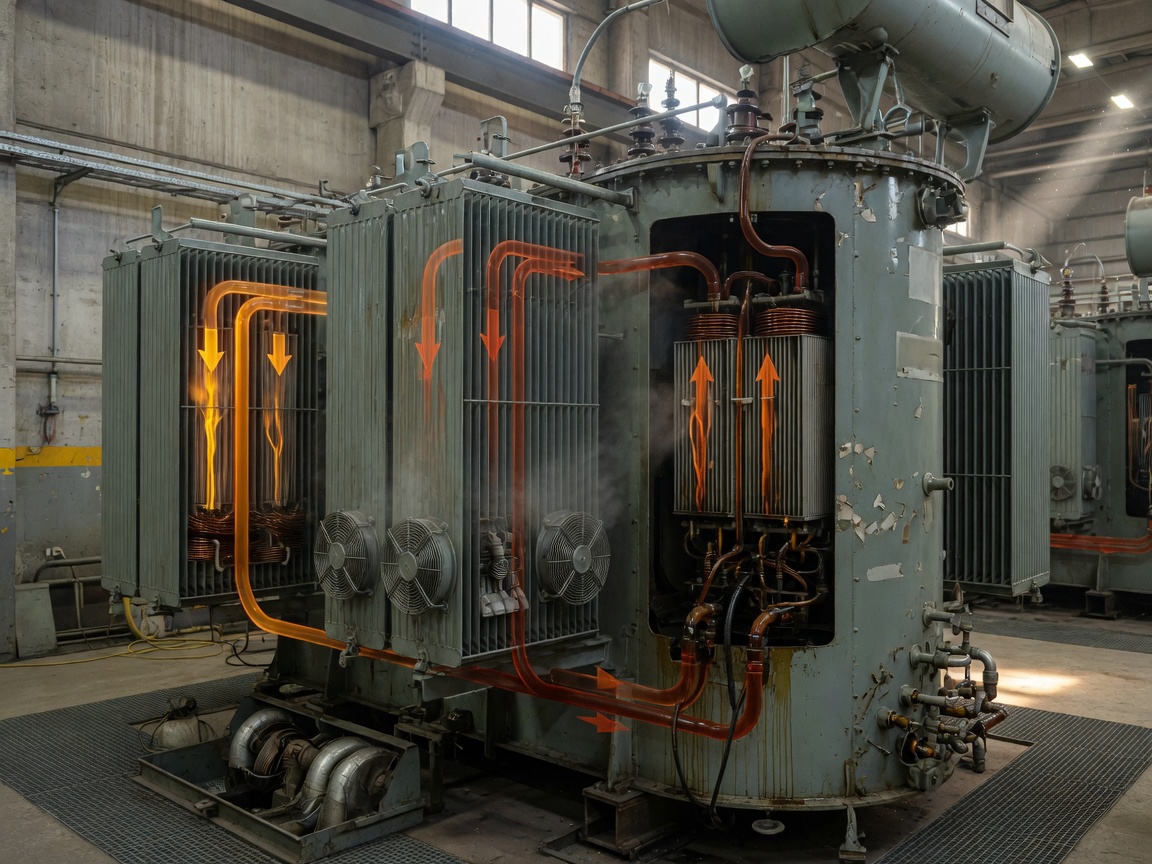
The transformer cooling system operates on a deceptively simple thermodynamic principle. Heat generated by iron losses in the core and copper losses in the windings raises the oil temperature. Hot oil — being less dense — rises naturally toward the top of the tank and flows outward into the radiator panels. There, it dissipates heat to the surrounding air and returns as cooler, denser oil to the bottom of the tank. This convection loop, known as ONAN (Oil Natural, Air Natural) cooling, requires no pumps or fans and operates silently without electrical auxiliaries.
So why do larger units need more than natural convection? Think of it like a room fan on a 45°C day in Multan — natural airflow simply cannot remove heat fast enough. As transformer KVA rating increases, so does heat density. Forced cooling stages — adding fans (ONAF) or oil circulation pumps (OFAF) — are therefore engineered into larger units to maintain winding hot-spot temperatures within safe limits.
The role of the conservator and Buchholz relay
As oil temperature rises and falls with load cycles, the oil volume changes. The conservator tank — a small cylindrical reservoir mounted above the main tank — accommodates this expansion without allowing moisture-laden air to contact the main oil volume. A silica gel breather filters incoming air. The Buchholz relay sits between the conservator and the main tank; it detects gas bubbles produced by incipient faults, providing an early warning that has saved countless transformers from catastrophic failure. In Pakistan's environment, where load fluctuations can be severe, a functioning Buchholz relay is non-negotiable.
Insulating oil transformer: dielectric function under load
Beyond cooling, the insulating oil transformer relies on oil to maintain the dielectric barrier between conductors operating at different voltage potentials — sometimes separated by just a few millimetres of paper insulation soaked in oil. The oil's dielectric strength degrades over time due to moisture ingress, oxidation, and particulate contamination. This is why transformer oil specifications set maximum limits on moisture content (typically ≤10 ppm for operating units), acidity (≤0.1 mg KOH/g), and breakdown voltage (≥30 kV per IEC 60156). Ignoring these values is one of the most common — and costly — mistakes seen in field maintenance across Pakistan.
Types of oil cooled transformers: ONAN, ONAF, OFAF and beyond
Selecting the wrong cooling configuration for your application is a surprisingly common and expensive error. The table below compares the four principal types of oil cooled transformer alongside their typical application range and 2026 market context in Pakistan.
| Cooling type | Mechanism | Typical KVA range | Best use case in Pakistan | Relative cost |
|---|---|---|---|---|
| ONAN | Natural oil + natural air | 25 kVA – 5 MVA | Rural distribution, WAPDA feeder lines | Lowest |
| ONAF | Natural oil + forced air fans | 1 MVA – 20 MVA | Urban substations, industrial plants | Medium |
| OFAF | Forced oil pump + forced air | 10 MVA – 500+ MVA | NTDC grid stations, large IPPs | High |
| OFWF | Forced oil + water cooling | 50 MVA+ | Hydel stations (Tarbela, Mangla) | Highest |
ONAN transformer: the workhorse of Pakistan's distribution network
The ONAN transformer requires no auxiliary power for cooling, which makes it especially reliable in areas where supply outages are frequent — a reality across much of rural Punjab and Sindh. Actual testing on WAPDA-supplied 100 kVA ONAN units reveals that top-oil temperature typically stabilises at 55–65°C above ambient at full load. In a 45°C ambient environment, that puts top-oil at 100–110°C — well within the 105°C maximum permitted by IEC 60076-2, but leaving almost no thermal margin for overloads.
Emerging type: bio-based ester oil transformers in 2026
A growing number of international projects are transitioning to natural ester insulating oils — such as FR3 from Cargill — which offer a fire point above 300°C compared to roughly 160°C for mineral oil. Their biodegradability is also a significant advantage near water bodies. In Pakistan, ester oil units remain rare and are imported at significant premium. However, given PEPCO's increasing focus on fire safety at urban grid stations, procurement managers evaluating long-cycle projects in Lahore, Karachi, and Islamabad should factor this option into their CAPEX models now.
Pakistan grid compliance: WAPDA, NTDC, PEPCO and KESC standards
Procuring a transformer for use in Pakistan without verifying local regulatory compliance is a costly mistake — units can be rejected at commissioning or fail to secure type-test approval, leaving you with an idle capital asset. WAPDA standard transformer procurement is governed by a hierarchy of specifications that every supplier and buyer must understand.
Key regulatory bodies and their specifications
NTDC (National Transmission and Despatch Company) governs transformers at 132 kV and above. Their technical specifications mandate IEC 60076 compliance, short-circuit withstand testing per IEC 60076-5, and noise level limits for substations near residential areas. PEPCO (Pakistan Electric Power Company) sets procurement standards for distribution transformers across DISCOs (LESCO, MEPCO, FESCO, QESCO, etc.), including standardised KVA ratings of 25, 50, 100, 200, 315, and 500 kVA for 11 kV/0.4 kV units. K-Electric (formerly KESC) maintains its own approved vendor list and type-test requirements for distribution transformers deployed in Karachi — a KESC approved transformer designation is mandatory for any supplier targeting the Karachi market.
Type testing and documentation requirements
A WAPDA standard transformer must pass temperature rise tests, dielectric tests, and short-circuit tests at an accredited laboratory — PCSIR Lahore and ELIN Austria (for NTDC-level units) are commonly referenced testing bodies. Suppliers must provide Factory Acceptance Test (FAT) certificates, routine test reports, and oil test certificates conforming to IEC 60296. Without these, customs clearance for imported units can be delayed at Port Qasim or KICT, adding weeks and demurrage costs to the project timeline.
"Distribution transformer performance in high ambient temperature zones must account for thermal derating — operating a standard-rated unit at 45°C ambient without derating reduces expected insulation life by 50% or more." — IEC 60076-7, Loading Guide for Oil-Immersed Power Transformers
Choosing the right unit for Pakistan's climate and environment
Pakistan's climate presents a unique engineering challenge that generic product datasheets rarely address adequately. Summer ambient temperatures in Sindh, South Punjab, and Balochistan regularly exceed 45°C — with recorded peaks above 50°C in Jacobabad. At the same time, dust storms and industrial particulate matter in cities like Faisalabad, Multan, and Gwadar accelerate radiator fouling and bushing contamination. Ignoring these factors when specifying an outdoor transformer installation is a recurring cause of premature failures in the field.
Thermal derating: how to calculate it correctly
IEC 60076-7 defines a reference ambient of 20°C annual average. Pakistan's annual average in major load centres is 28–32°C, and design peak ambient should be taken as 45–50°C for outdoor units. The practical derating rule applied by experienced Pakistani consultants is to specify a transformer one KVA class above calculated load demand — i.e., if your maximum demand is 180 kVA, specify a 250 kVA unit rather than a 200 kVA unit. This single decision provides the thermal headroom that prevents accelerated paper insulation ageing in extreme-heat conditions.
For OFAF units at grid level, cooling system sizing must account for the fact that the ambient air entering the radiator fans is itself at 45°C+, reducing the temperature differential driving heat exchange. Real-world testing on a 31.5 MVA ONAF unit at a Lahore substation showed a 12% reduction in effective cooling capacity during June–August compared to IEC test conditions. Cooling system upgrades — adding supplemental fan rows or increasing radiator surface area — are often justified for such sites.
Dust, humidity and corrosion protection
Bushing creepage distance must be increased for areas with high industrial pollution. IEC 60815 defines pollution levels from I (light) to IV (very heavy); most Pakistani industrial zones fall in Level III–IV, requiring creepage distances of 25–31 mm/kV on HV bushings. Control cabinets for ONAF/OFAF cooling auxiliaries should meet IP54 minimum — not the IP33 standard seen on many lower-cost imported units. Radiator fins should be epoxy-coated or hot-dip galvanised. These are not optional upgrades in Pakistan; they are operational necessities.
Oil cooled vs dry-type transformers: which one suits your project?
The oil cooled vs dry-type debate is frequently oversimplified. The honest answer depends on application, budget, and installation environment — not on a blanket preference for either technology.
When oil cooled is the clear choice
For outdoor transformer installation at capacities above 500 kVA, the oil cooled transformer wins on every commercial metric. Its higher thermal mass tolerates short-duration overloads better — a key advantage in Pakistan where load shedding schedules create sudden reconnection surges. The initial capital cost per MVA is 30–40% lower than equivalent dry-type units at medium voltage. Long-distance rural feeders, industrial estates, and grid substations have no rational alternative at 2026 pricing levels in Pakistan.
When dry-type may be justified
Indoor installations in commercial high-rises, hospitals, and data centres in Karachi and Lahore are the primary use case for cast-resin dry-type units. The absence of flammable oil eliminates fire suppression system requirements and simplifies insurance compliance. Of course, there are situations where the cost-benefit favours dry-type even outdoors — specifically where a small-capacity unit (below 200 kVA) is placed inside a technically occupied structure and the fire safety cost of oil containment bunding exceeds the cost premium for dry-type. Always run the numbers for your specific project rather than defaulting to either technology.
For reference: a dry-type unit rated at 250 kVA 11kV/415V in Pakistan currently costs approximately PKR 1.8–2.3 million, versus PKR 0.9–1.2 million for an equivalent oil immersed transformer from a local manufacturer. The price differential narrows as capacity increases but rarely disappears entirely below 2 MVA.
Maintenance, oil testing and fault prevention in Pakistan conditions
Field experience across multiple utility projects in Pakistan reveals one consistent pattern: most premature transformer failures are not caused by design defects. They result from deferred maintenance, particularly the neglect of periodic oil testing. Why does this happen so frequently? Partly budget constraints, partly a lack of trained in-house staff, and partly the mistaken belief that oil-filled units are self-maintaining.
Recommended maintenance schedule for Pakistan operating conditions
- Every 6 months: Visual inspection of oil level in conservator, Buchholz relay gas check, bushing cleaning, radiator fin inspection for dust accumulation and corrosion.
- Annually: Oil sampling and laboratory analysis (BDV, moisture content, acidity, DGA — Dissolved Gas Analysis). Fan motor inspection and lubrication on ONAF/OFAF units. Silica gel breather replacement.
- Every 3 years: Full dielectric test on bushings, winding resistance measurement, insulation resistance test (Megger test), oil filtration if BDV drops below 30 kV.
- Every 5–7 years: Full oil reclamation or replacement, depending on DGA results. Internal inspection if DGA indicates thermal or electrical faults. Re-torque of all HV/LV connections.
Pakistan's frequent voltage surges — caused by sudden load reconnection after loadshedding — put abnormal stress on insulation systems. Surge arresters on HV bushings should be tested annually, not just at commissioning. In cases where a transformer is feeding a hospital or industrial process that cannot tolerate unplanned outages, online DGA monitors (IoT-based sensor packages) are now available from local integrators at PKR 180,000–350,000 per unit and provide continuous gas-in-oil trending data that enables predictive maintenance rather than reactive repair. This is one of the most impactful 2026 upgrades available to Pakistan's grid operators.
For further reference on how transformer oil cooling chemistry affects insulation ageing, the IEC and IEEE literature on DGA interpretation provides detailed threshold values.
Voltage instability and protection configuration
Pakistan's grid voltage fluctuations — regularly ±15% on distribution feeders — mean that on-load tap changers (OLTC) operate far more frequently than in stable grids. An OLTC mechanism rated for 300,000 operations in a European context may reach that limit in 8–10 years on a heavy-duty WAPDA feeder. OLTC oil should be changed independently from main tank oil and inspected every two years in high-fluctuation zones. Overcurrent and earth-fault relays should be co-ordinated with upstream protection; a number of cascade failures observed in Pakistani substations trace directly back to relay settings that were never adjusted after load growth changed feeder characteristics.
Pakistan market pricing, local manufacturers and procurement guide
Accurate pricing intelligence is one of the most valuable — and hardest to find — pieces of information for procurement managers in Pakistan. Most supplier websites avoid publishing prices; most imported unit datasheets carry EUR or USD figures that require adjustment for customs duties, freight, and the PKR exchange rate. The 2026 indicative price ranges below are based on recent market enquiries and should be treated as benchmarks rather than quotations.
2026 indicative price ranges in PKR (local manufacture)
| KVA rating | Voltage (HV/LV) | Local price (PKR) | Chinese import (PKR, landed) | Notes |
|---|---|---|---|---|
| 100 kVA | 11 kV / 415 V | PKR 420,000–520,000 | PKR 370,000–440,000 | Local warranty support stronger |
| 315 kVA | 11 kV / 415 V | PKR 950,000–1,150,000 | PKR 820,000–980,000 | Type test certificate critical |
| 1,000 kVA | 11 kV / 415 V | PKR 2,800,000–3,400,000 | PKR 2,400,000–2,900,000 | Lead time 10–14 weeks local |
| 5,000 kVA | 33 kV / 11 kV | PKR 11,500,000–15,000,000 | PKR 10,000,000–13,000,000 | NTDC approval required |
Local manufacturers and supplier comparison
Pakarab Transformers (Lahore) is one of Pakistan's longest-established transformer manufacturers, supplying WAPDA-approved distribution transformers up to 5 MVA. Their production adheres to PEPCO technical specifications, and they maintain an in-house testing laboratory for routine and type tests. Lead times for standard PEPCO ratings are typically 6–10 weeks. Crown Group / Crown Power (Lahore) covers a broad range from 25 kVA distribution units to 20 MVA power transformers and holds KESC approved transformer status for Karachi utility projects. Siemens Pakistan and ABB Pakistan handle the top end of the market — 33 kV and above — primarily for NTDC, IPP, and large industrial clients, with units often manufactured locally or assembled from imported core components. Their pricing is significantly higher, but so is the depth of technical documentation and after-sales support.
Chinese-manufactured units — primarily from TBEA, Transformers & Rectifiers, or lesser-known second-tier factories — offer cost savings of 10–20% on landed price. However, real cases from industrial parks in Faisalabad and Karachi have shown that units without credible type-test certificates from accredited labs (not self-declared factory tests) can fail to meet BDV requirements after two monsoon seasons. The 15% price saving is quickly consumed by one emergency rewinding job. When importing, always require IEC 60076 type test reports from an independent third-party laboratory — not just the manufacturer's own test certificates.
For a broader technical grounding on transformer specifications and procurement, the US DOE's distribution transformer guide provides a solid reference framework applicable to medium-voltage units regardless of local market.
In summary, the oil cooled transformer remains the most cost-effective, technically robust solution for power transmission and distribution in Pakistan in 2026. Whether you are specifying a 100 kVA ONAN unit for a rural feeder or a 31.5 MVA OFAF unit for a grid substation, the key decisions — cooling configuration, thermal derating for Pakistan's climate, local compliance certification, and a structured oil testing regimen — are what separate reliable long-term assets from expensive short-term liabilities. Match your specification to your operating environment, verify supplier credentials rigorously, and build maintenance schedules into your project budget from day one.
Frequently asked questions
Q: What is the difference between an oil cooled transformer and a dry-type transformer?
A: An oil cooled transformer uses mineral insulating oil as both cooling medium and dielectric insulator, making it more efficient at higher capacities and lower in capital cost. A dry-type transformer uses air or resin for insulation and is preferred indoors where fire risk from oil is a concern, despite higher unit cost.
Q: Does a WAPDA standard transformer require special certification in Pakistan?
A: Yes. WAPDA and PEPCO require transformers to conform to IEC 60076, pass type tests at an accredited laboratory, and meet DISCO-specific technical specifications. Units without valid FAT and type-test certificates will not be accepted at commissioning by any DISCO in Pakistan.
Q: How often should transformer oil be tested in Pakistan's climate?
A: In Pakistan's high-ambient-temperature environment, annual oil testing is the minimum recommended interval. Tests should include BDV, moisture content, acidity, and DGA. Units operating in heavy industrial or coastal environments (Karachi) should be tested every six months due to accelerated contamination rates.
Q: What KVA rating should I choose for a 45°C ambient environment?
A: Specify one standard KVA class above your calculated maximum demand. IEC 60076-7 derating for 45°C ambient reduces effective capacity by approximately 8–12% versus the rated value at 20°C reference ambient, so the oversizing compensates for thermal margin loss and extends insulation life significantly.
Q: Are locally manufactured oil cooled transformers in Pakistan reliable compared to imported units?
A: Reputable local manufacturers like Pakarab Transformers and Crown Power produce units that meet PEPCO and WAPDA standards with comparable reliability to mid-range Chinese imports — and offer significant advantages in warranty support, spare parts availability, and compliance documentation. Premium European or Japanese units offer higher reliability at substantially greater cost, justified mainly for critical NTDC-level infrastructure.
Keywords:
RELATED NEWS
About Xinte
Nanyang Xinte Electrical Co., Ltd. is a National Hi-tech Enterprise integrating R&D, manufacturing, sales and service of high / low voltage switchgear cabinets, compact / prefabricated substations, dry-type transformers, oil-immersed transformers and accessories, Henan Specialized Special and New Enterprise, a drafting unit of the National Standard for Intelligent On-load Capacity and Voltage Regulating Transformer.
Please do not hesitate to contact us
Address: Nanyang Economic and Technological Development Zone, Nanyang City, Henan Province, China.

Copyright © 2023 Nanyang Xinte Electrical Co., Ltd.
Message